Are you designing the corrosion protection of your photovoltaic plant using generic tables?
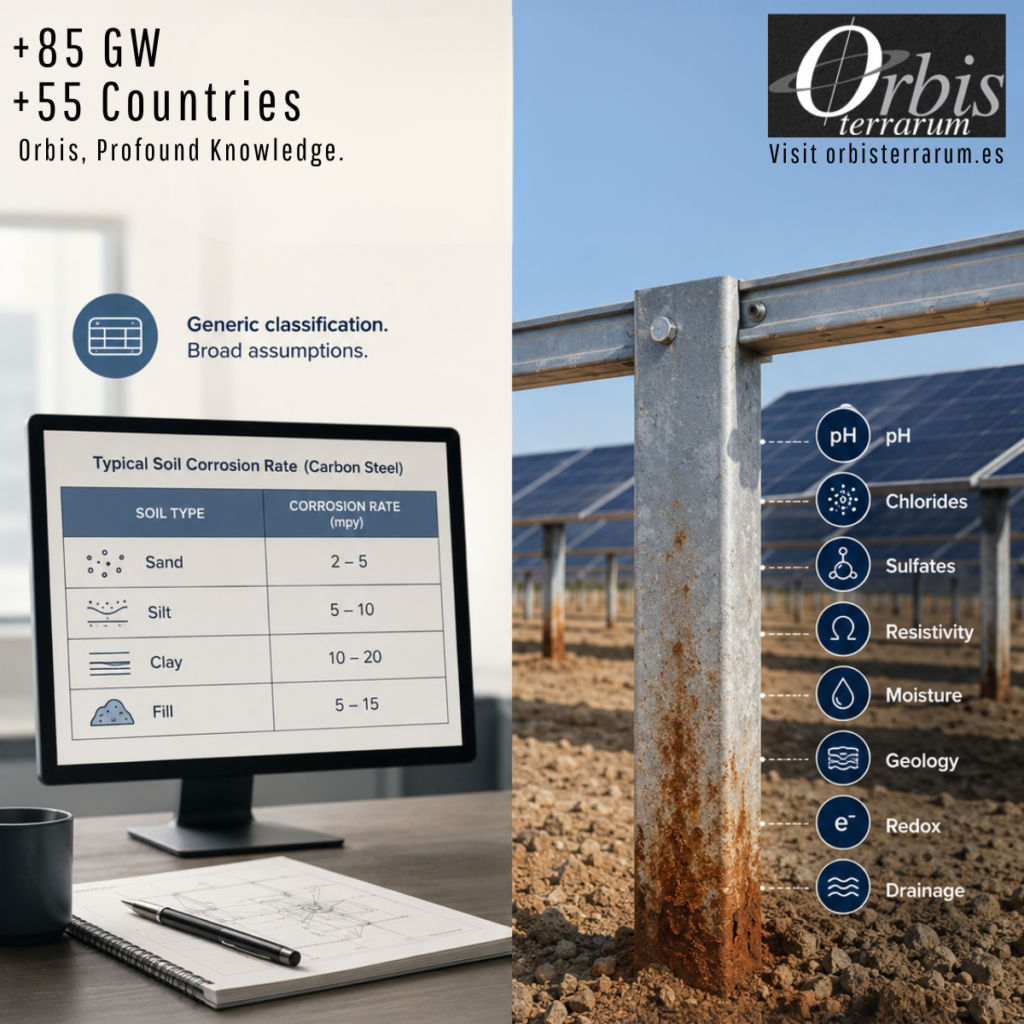
You may be making a serious mistake. Not because tables have no value, but because they probably do not reflect the actual soil corrosion conditions at your plant.
In many projects, soil aggressiveness is estimated from simplified classifications: sand, silt, clay, fill… But the corrosion of carbon steel, galvanized steel, Zn-Al-Mg alloys or grounding copper does not depend only on the “soil type”.
It depends on the real combination of site-specific factors.
Two soils with the same classification can generate very different corrosion rates. In addition, many guidelines mainly focus on steel and galvanized steel, while materials such as copper or Zn-Al-Mg alloys are more complex to assess.
That is why, at @OrbisTerrarum, we study soil corrosion in photovoltaic plants using an integrated methodology:
detailed geology + physical-chemical soil testing + field and laboratory electrochemistry.
We do not assign a corrosion rate based solely on literature. We evaluate the real behaviour of materials in contact with the specific soil of each plant.
This approach allows us to identify which factors control corrosion, which areas may be more critical, which corrosion rates are reasonable for design, and which protection solutions make the most technical sense.
Tables can guide. But the real soil decides.
And when it comes to the durability of a photovoltaic plant, measuring properly is not an extra: it is a design necessity.
info@orbisterrarum.es | orbisterrarum.es

